
Home Battery Installation on the Central Coast, Your Complete Guide
Home battery storage has gone from a niche product to a mainstream energy upgrade for Central Coast households. As electricity prices continue to rise and feed-in tariffs drop, more Gosford homeowners are looking at batteries as a way to keep more of their solar energy and reduce their dependence on the grid. Here's a practical overview of what's involved and what to consider before adding battery storage to your home.
How a Home Battery Works With Solar
A home battery stores excess electricity generated by your solar panels during the day. Without a battery, any solar energy your home doesn't use immediately gets exported to the grid at a relatively low feed-in tariff. With a battery, that surplus energy is stored and used later, in the evening, overnight, or during peak tariff periods when grid electricity is most expensive.
The result is that more of the energy your solar system generates is consumed by your household rather than sold back cheaply. For many Central Coast homes, this shift from exporting to self-consuming is where the real savings come from.
Most modern battery systems also provide backup power during grid outages. The level of backup depends on the battery capacity and how your system is configured, some setups back up the entire home, while others protect only essential circuits like fridges, lights, and internet.
Adding a Battery to an Existing Solar System
If you already have solar panels on your roof, adding a battery is usually possible. The key factor is your current inverter. If your system was installed with a hybrid inverter, which has become common in recent years, adding a battery is a relatively straightforward connection. If you have a standard string inverter, you'll either need to upgrade it to a hybrid model or add a separate battery inverter (known as AC coupling). Both approaches work well, and your electrician can assess which option is the most practical and cost-effective for your existing setup.
Where Is the Battery Installed?
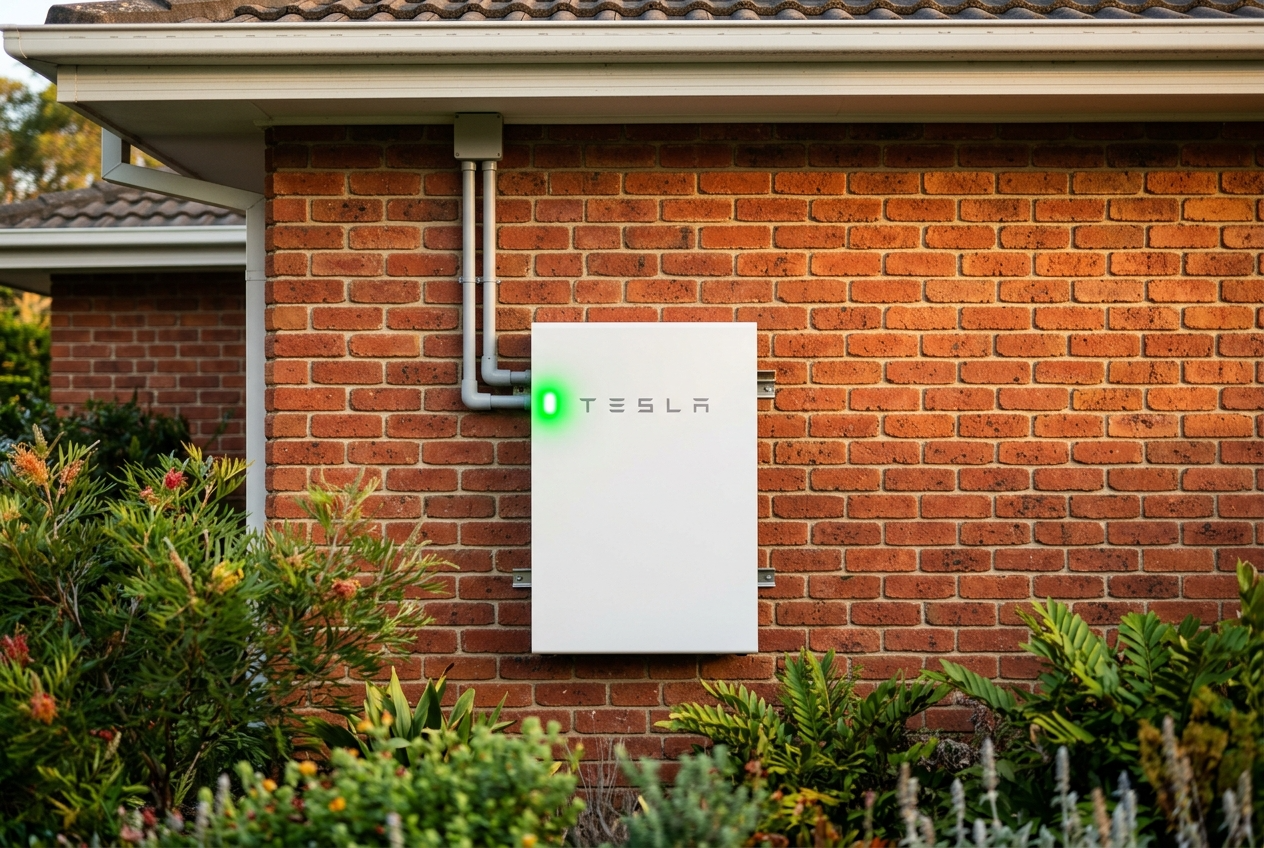
In Australia, home batteries are commonly installed on an exterior wall of the house, typically under the roof eave for protection from direct sun and rain. Brick, rendered, and concrete walls provide the most suitable mounting surfaces. The battery needs to be positioned within a reasonable cable distance of your switchboard and inverter, with adequate ventilation and the correct clearances as specified by the manufacturer.
Your installer will assess the best location during the site visit, considering factors like wall strength, cable routing, accessibility for future maintenance, and any local fire safety requirements. Some batteries can also be ground-mounted on a concrete slab if wall mounting isn't suitable.
Choosing the Right Battery for Your Home
There are several reputable battery brands and chemistries available in the Australian market, each with different storage capacities, power output ratings, warranty terms, and features. The right battery for your home depends on your daily energy usage patterns, the size of your solar system, how much backup protection you want, and your budget.
A responsible installer won't push a particular brand. Instead, they'll analyse your actual consumption data and solar generation to recommend a battery that genuinely matches your household's needs, not the biggest or most expensive option for the sake of it.
Installation and Compliance
Home battery installation must be carried out by a licensed electrician with Clean Energy Council (CEC) accreditation. The work involves mounting the battery unit, installing DC and AC isolator switches, running cabling between the battery, inverter, and switchboard, and configuring the system settings. All work must comply with Australian standards, and the installation will be inspected and certified with a certificate of compliance.
Depending on your energy distributor, there may also be an application process for connecting battery storage to the grid, similar to the process for solar installation.
Frequently Asked Questions About Home Batteries on the Central Coast
Will a battery eliminate my electricity bill entirely?
It depends on your system size, battery capacity, and usage patterns. A battery will significantly reduce how much electricity you draw from the grid, but most households will still have some grid usage during extended cloudy periods or high-demand seasons.
How long do home batteries last?
Most home batteries come with a manufacturer warranty covering a set number of years and charge cycles. The actual lifespan depends on how the battery is used and the environmental conditions at the installation location.
Are there government rebates for batteries in NSW?
Government incentive programs for battery storage change from time to time. Your installer can advise on any current rebates, interest-free loan schemes, or incentives available in NSW at the time of your enquiry.
Can I go completely off-grid with a battery?
It's technically possible but requires a significantly larger solar and battery system than most grid-connected homes need, plus additional equipment like a backup generator. For most Central Coast homes, staying connected to the grid while using solar and battery to minimise grid reliance is the more practical approach.
Talk to a Local Central Coast Electrician
Ready to explore battery storage for your home? Chat with our team to arrange a free assessment of your current solar system.